The method
The FizzUp Loop. Designed around how people actually learn to speak.
No neuroscience slogans. No promises you can’t check. One idea holds it all together: the conversation is the unit of learning. Reviews, tools and the library exist to make your next conversation better than the last.
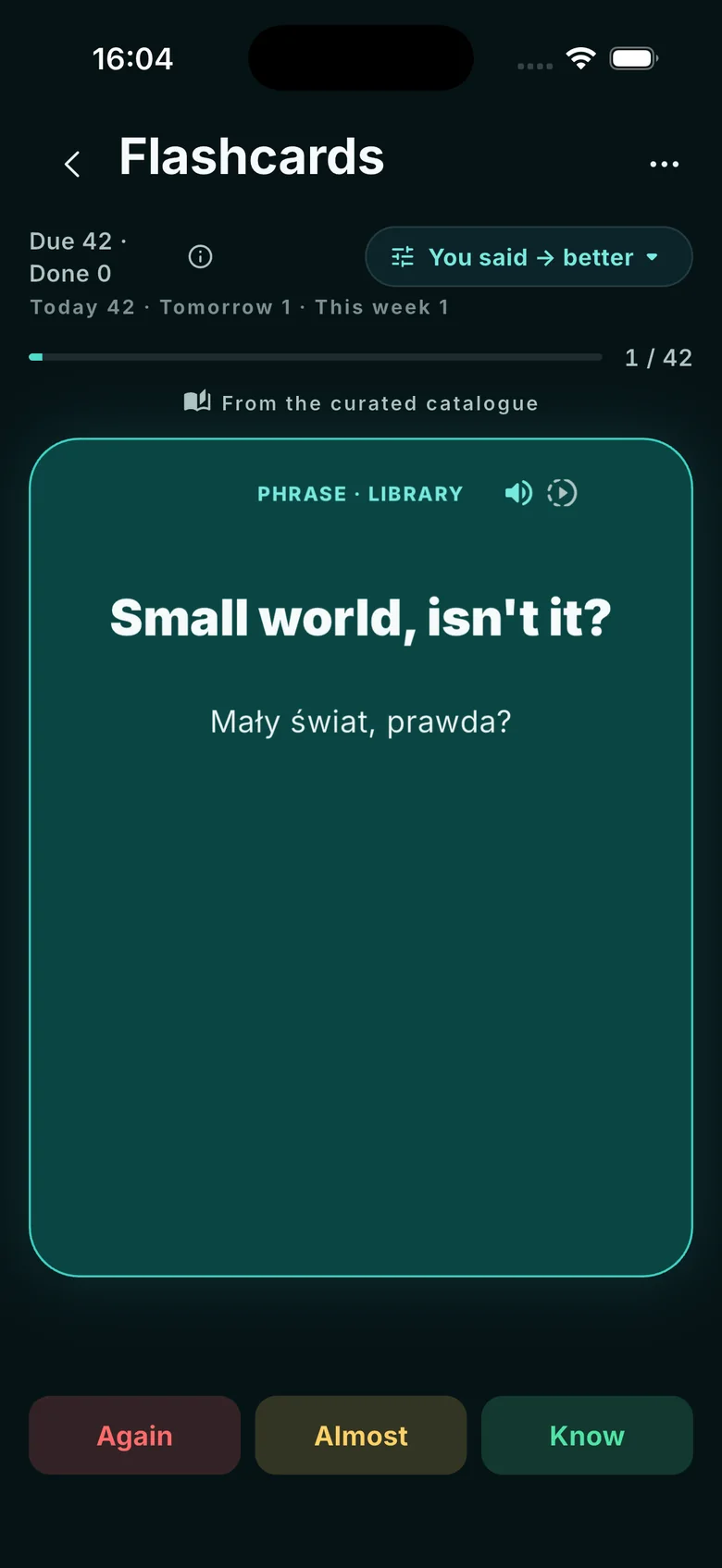
Say → See → Fix → Keep → Use again
Five steps. The same loop, whatever you talk about.
- 1
Say
You talk about what’s actually in front of you. Your AI coach leads the conversation and doesn’t stop you mid-sentence to correct you.
- 2
See
After the conversation you see your sentences next to better versions. During it, your AI coach works on one thing at a time, at most; afterwards you get a short list to choose from.
- 3
Fix
A correction that fits the moment: a better version, a nudge to find it yourself, or — for now — nothing. And you always know why.
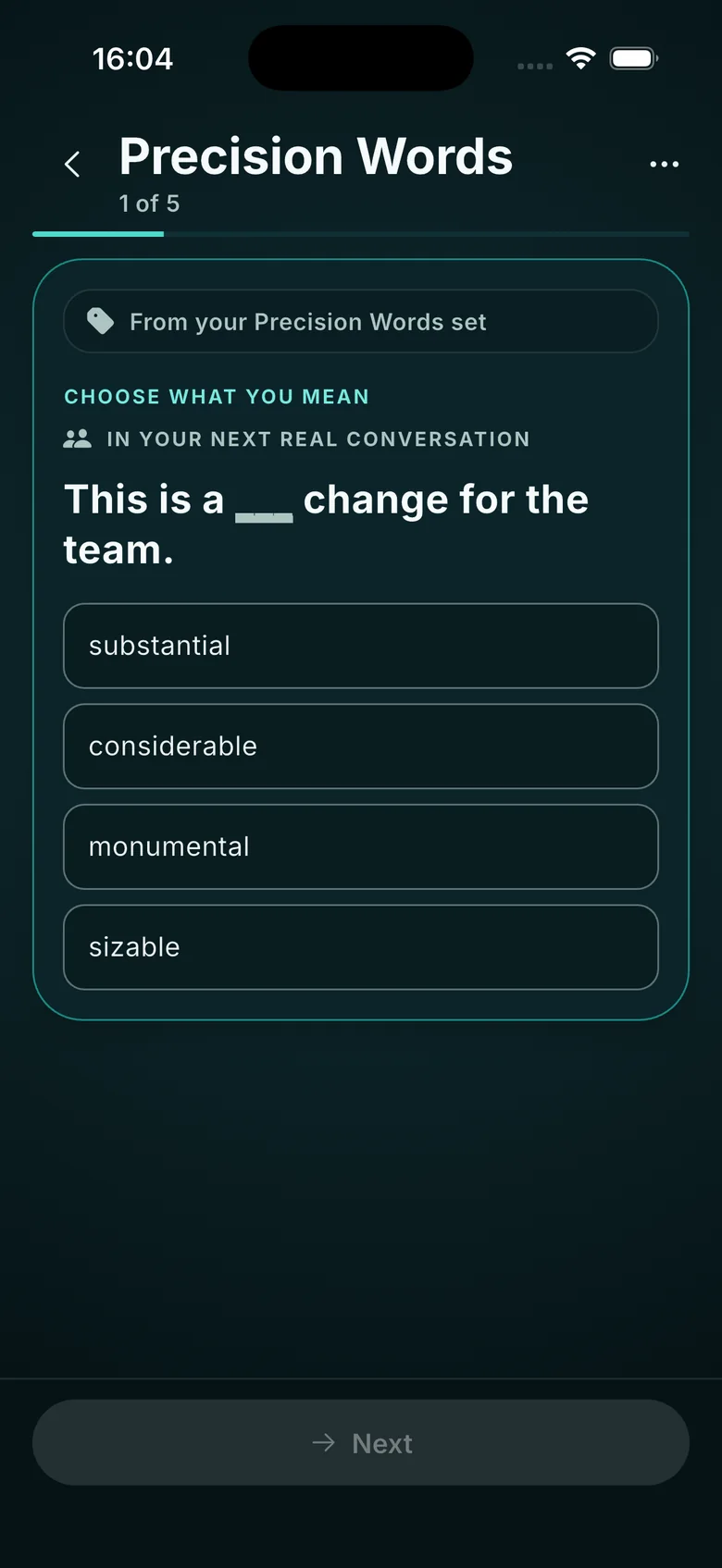
Precision Words: pick the word that says exactly what you mean. - 4
Keep
Nothing to copy out. A phrase that mattered comes back on its review day — the calendar shows what’s up for review today.
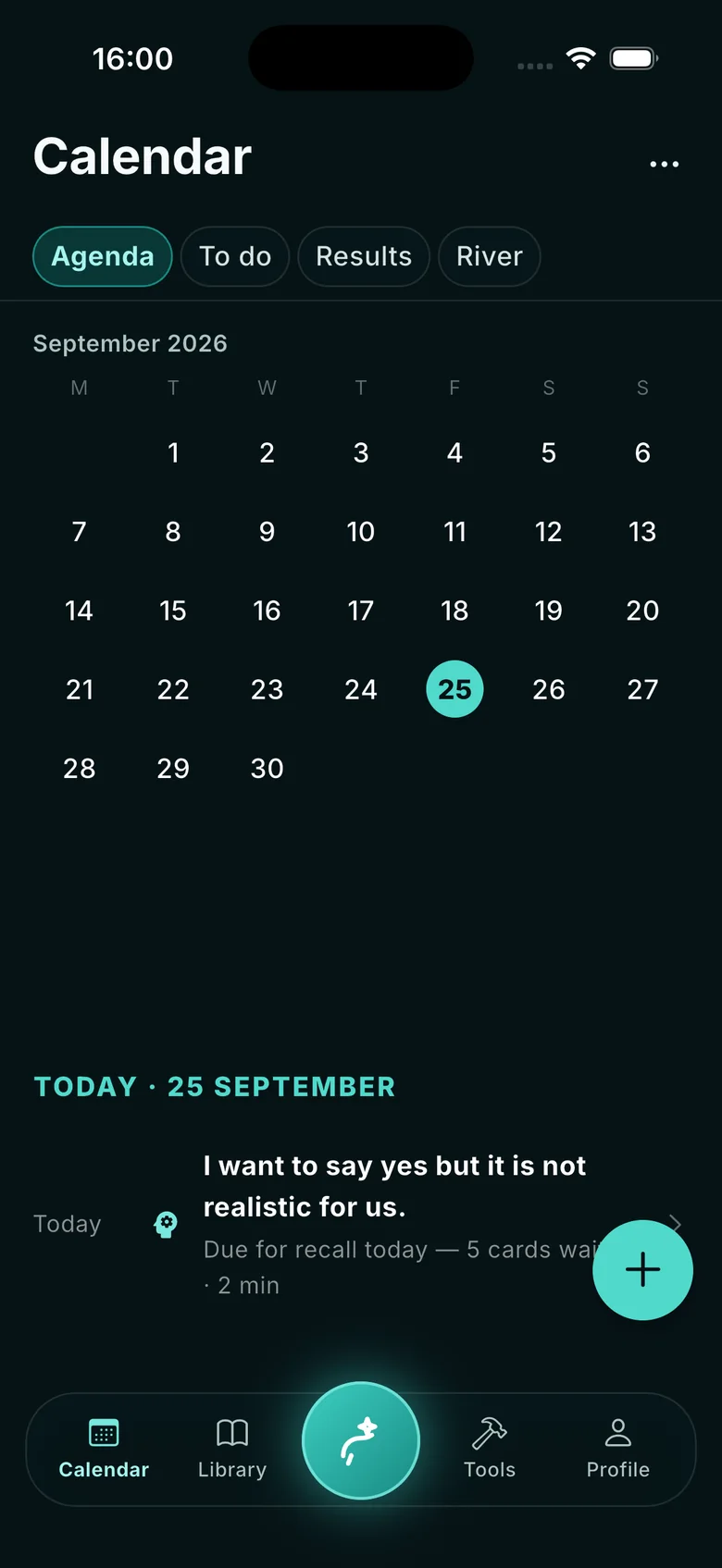
The calendar: one sentence to review today — two minutes. - 5
Use again
Days later, in a new conversation, you say it yourself. Each conversation picks up where the last one left off.
Use again
This is how we count progress: only when you say it yourself — at least a day later, in a new conversation, before your AI coach prompts you.
Repeating it right after you’ve heard it doesn’t count. The “Used again” screen that will show you these moments is being built. Until then, Progress shows an estimated level — a rough guide, not a measurement.
Screens from a demo account with a sample conversation history, taken from different conversations — the loop is the same whatever the topic.
Your AI coach in the loop
What your AI coach does at each step.
The loop is the same whoever you choose. Your AI coach walks you through it — each of the four in their own way.
1Say
Opens by asking about what’s going on for you, then keeps the conversation moving: Malcolm asks how your week’s been, Theo what you’re preparing for, Sophie how your day is going, Emma what’s on your plate at work.
2See
During the conversation, works on one thing at a time, at most. You see the rest afterwards: your sentences next to better versions.
3Fix
Picks the right kind of correction for the moment and lets you say the sentence again. Malcolm weaves the better version into his reply, Theo asks you to say it again, cleaner, Sophie corrects in passing, and Emma works on your tone.
4Keep
At the end of the conversation, suggests a few phrases to keep. The ones you keep go into your flashcards and come back on their review day.
5Use again
In the next conversation, may bring back a phrase that’s waiting for review. What counts is the moment you say it yourself — before your AI coach prompts you.
What all four of them stick to.
- Conversation first, form second — and no cutting you off.
- At most one correction at a time.
- A correction that fits the moment: a better version, a nudge, or nothing for now.
- After a correction, you say the sentence again — yourself.
- Stuck? A phrase to get going, a slower pace, or a simpler question.
- Warm, never shaming, and no points for pronunciation.
- Openly AI — they don’t pretend to be people.
- Memory you can see and delete.
That’s the design. How well they stick to it in conversation, we keep checking and improving.
All the principles, and how each of the four runs a conversation ›Fix
A correction that fits the moment.
A correction that fits the moment: a better version, a nudge to find it yourself, or — for now — nothing. And you always know why. Your AI coach doesn’t tally up your mistakes or grade you — it shows you how to say it better, or helps you find it.
A better version
When one word fixes it.
Your AI coach gives you the finished sentence. It’s the quickest route when the slip is a word-for-word translation you can easily hear.
- You say
- “I have 30 years.”
- AI coach
- “I'm 30.”
- Why
- Age is a number, not something you 'have' — one of the most recognisable Polish-to-English calques, fixed with a single word.
A nudge
When you know the rule but didn’t use it.
Your AI coach doesn’t hand you the answer. It points you towards it and asks you to say the sentence again.
- You say
- “Yesterday I go to the cinema.”
- AI coach
- “Ah — so yesterday you… how do we say ‘go’ in the past?”
- You say it again
- “Yesterday I went to the cinema.”
- Why
- A form you find yourself is easier to recall later.
Nothing for now
When it matters more that you keep talking.
Your AI coach doesn’t correct. It asks what you mean and lets you finish your thought.
- You say, hesitating
- “The meeting was… difficult, because the client… he want more.”
- AI coach
- “What did he ask for?”
- Why
- When speaking feels like hard work, a correction right then would get in the way more than it would help.
Illustrative examples we wrote — not quotes from learners’ conversations. What we describe here is the principle your AI coach uses to choose a correction.
Boundaries
What we don’t do.
We do not score pronunciation.
Pronunciation Lab is a preview: you hear how it should sound, read how to place your lips and tongue, and practise words and minimal pairs. You get no score, because we don’t have a measurement we trust enough to show you.
We do not pretend a number is evidence.
When there isn’t enough evidence, the app says so. The estimated level you see in Progress today is a rough guide — not an exam result.
We do not keep everything.
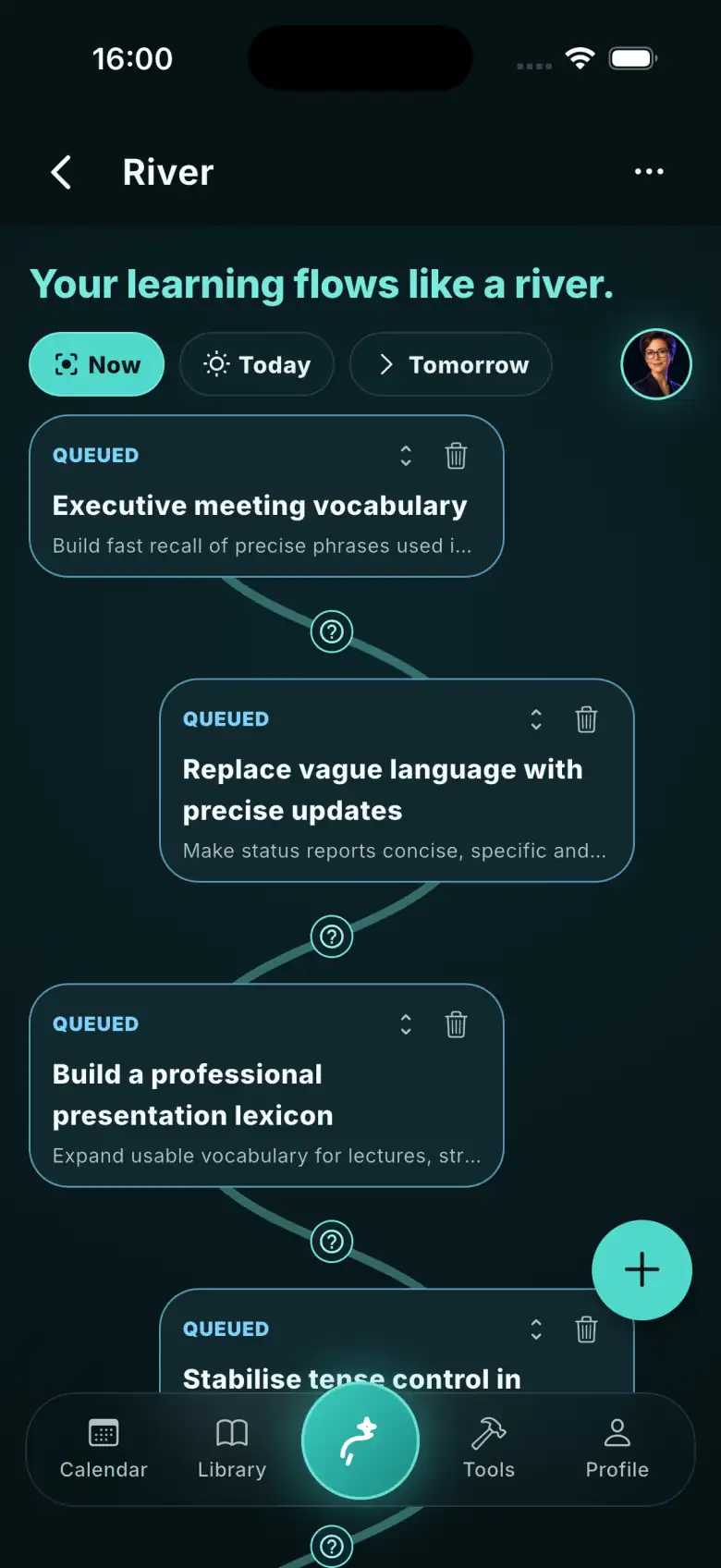
Context is selective: what you’re working on, not a record of your life. You can see it and delete it, and reorder or remove the steps in your learning plan.
We do not pretend to be human.
Your AI coach tells you plainly that it’s AI — that’s how we designed it. It has a voice, a character and a memory of what you’re working on together.
Principles
Five ideas it’s built on.
None of them is our invention. Our job was to make them work together inside one conversation, not scattered across five tabs.
- 1
Conversation
You learn to speak by speaking. Picking an answer trains recognition, not speech — and in real life nobody hands you four options.
- In FizzUp
- The conversation is the unit of learning: everything starts there and everything comes back to it.
- 2
Retrieval
Pulling a phrase out of your own head takes more effort than reading it off a list — which is exactly why it sticks.
- In FizzUp
- In a review, you say how close you were — Again, Almost or Know — and that decides when the phrase comes back.
- 3
Context
A word you met in a sentence someone actually said comes back more easily than the same word in a list of twenty.
- In FizzUp
- Phrases you keep from a conversation go into your flashcards. Catalogue cards are labelled, so you always know where a card comes from.
- 4
Spaced review
Material comes back at growing intervals, just as you start to forget it. Too early and less of it sticks; too late and you’re learning it from scratch.
- In FizzUp
- A review schedule based on the SM-2 algorithm. The calendar shows what’s up for review today.
- 5
Feedback
There’s no single best correction. Sometimes a ready-made better version helps, sometimes a question that points the way, and sometimes it’s better not to interrupt. Most of it sticks when you say the sentence again yourself after the correction.
- In FizzUp
- The kind of correction depends on the mistake and on how the conversation is going. If you’ve broken a rule, your AI coach nudges you and asks you to say it again; if you’re stressed, or the mistake doesn’t get in the way of meaning, it gives you a better version or lets it go.
Names and sources are further down, in the section for teachers and researchers. What we already measure — and what we don’t claim yet — is on the Evidence page.
For teachers and researchers
What the loop draws on.
The FizzUp Loop isn’t a new theory. It applies a few well-documented principles from second language acquisition research — inspired by them, not validated by them. At every step, we say what we don’t know yet.
Say
Pushed output
M. Swain (1985, 1995).
- In the app
- Talking — out loud or in text — is the default way of working.
- What we do not know yet
- Whether what learners say gets longer and more complex over time — we don’t yet measure this in a comparable way.
See
Noticing
R. Schmidt (1990).
- In the app
- After the conversation, your sentence sits next to a better version.
- What we do not know yet
- Whether learners actually notice the difference — we don’t measure that.
Fix
Choosing the right feedback
Feedback types and uptake — R. Lyster and L. Ranta (1997).
- In the app
- Three modes: a better version (recast), a nudge that asks you to say it again (elicitation), and no correction when speaking is a struggle.
- What we do not know yet
- In voice conversations, the correction mode is an instruction to the model, and we check that it’s followed internally. We don’t yet record whether you say the sentence again after a correction.
Keep
Spaced retrieval
Review spread out over time, and recall from memory.
- In the app
- A review schedule based on the SM-2 algorithm.
- What we do not know yet
- We haven’t calibrated the intervals for spoken phrases.
Use again
Transfer to a new situation
What we count is narrower: recalling it on your own in a new conversation.
- In the app
- A phrase counts when it comes back at least a day later, in a new conversation, before your AI coach prompts it. We discard cases where the phrase was on screen or in the scenario.
- What we do not know yet
- We’re checking detection accuracy on a hand-checked sample before we show it to learners.
What we don’t claim: that FizzUp is more effective than other methods; that the A2–C1 labels on our content have passed external CEFR validation; that the estimated level in Progress is a measurement.
We’re planning a pilot study, and we’ll publish its plan before it starts.
Thoughts on the method? Write to piotr@fizzup.ai — I reply personally.
Sources
- Swain, M. (1985). Communicative competence: Some roles of comprehensible input and comprehensible output in its development.
- Swain, M. (1995). Three functions of output in second language learning.
- Schmidt, R. (1990). The role of consciousness in second language learning. Applied Linguistics 11(2).
- Lyster, R., Ranta, L. (1997). Corrective feedback and learner uptake. Studies in Second Language Acquisition 19(1).
For L&D teams: a pilot lets you test this method on your own people — with criteria agreed before it starts.
Let’s talk about a pilot ›The conversation ends. The learning doesn’t.
Choose who you want to talk to — and bring one real thing you’re dealing with.
Download FizzUp
The app is free: no subscriptions, no in-app purchases, no ads.